


Page 20 - Code de Vino, #12/18, s/s 2016
P. 20
20   The Space of Taste                                                                Code de Vino #12               Code de Vino #12                                                                        Burgundy   21

            Background
            The Burgundians were one of the ancient Germanic tribes. The
            Scandinavian sagas name the Danish island of Bornholm as their
            ancient homeland. After settling on the continent, the
            Burgundians migrated westward, first establishing a kingdom with
            Geneva as its capital. In antiquity, the Burgundians formed an
            alliance with Rome, which would turn out to be a great benefit to
            both at various times. The Burgundians were easily assimilated by
            the Roman population and adopted many of the features of
            Roman culture, including its love of the vine. Before converting to
            Catholicism, they professed Arian Christianity. They also
            maintained good relations with Byzantium.
            The Burgundians were spread across a wide territory: in the
            Middle Ages, the Burgundian kings controlled land from
            Switzerland and Lyon to Marseille. But that kingdom did not
            occupy the territory of modern Burgundy. To the north of the
            kingdom, there was also the Duchy of Burgundy with its capital in
            Dijon, inhabited by the Burgundians that were conquered by the
            Franks in the early Middle Ages. That is the polity to which
            modern Burgundy traces its origins, after it gradually regained its
            independence from the Franks and established its influence over
            the region. The Duchy of Burgundy reached its golden age in the
            fifteenth century, having conquered the Netherlands, Flanders,
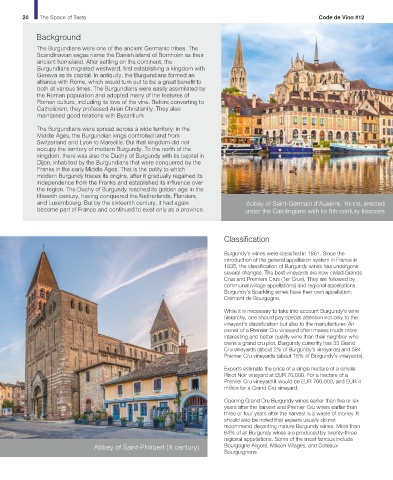
            and Luxembourg. But by the sixteenth century, it had again    Abbey of Saint-Germain d'Auxerre, Yonne, erected
            become part of France and continued to exist only as a province.  under the Carolingians with its 9th century frescoes


                                                                                                                                                                                                              Vineyards in Chablis
                                                                   Classification
                                                                   Burgundy’s wines were classified in 1861. Since the        Wine Subregions of Burgundy                         They can be quite expensive; for example, twelve bottles of 1983
                                                                   introduction of the general appellation system in France in                                                    vintage Chablis Le Clos Grand Cru were purchased for USD 3,000 at
                                                                   1935, the classification of Burgundy wines has undergone                                                       an auction in Stockholm in 2011. Grand Cru wines go well with veal,
                                                                   several changes. The best vineyards are now called Grands   Burgundy has several large wine regions:           complex dishes with sauces, or Italian risotto with mushrooms.
                                                                   Crus and Premiers Crus (1er Crus). They are followed by
                                                                   communal (village appellations) and regional appellations.   • Chablis and Grand Auxerrois                     The harvest year is very important for Chablis wines. Of the recent
                                                                   Burgundy’s Sparkling wines have their own appellation:     • Côte-de-Nuits and Hautes Côtes de Nuits           vintages, 2002, 2005, and 2010 particularly deserve mention.
                                                                   Crémant de Bourgogne.                                      • Côte de Beaune and Hautes Côtes de Beaune
                                                                                                                              • Côte Chalonnaise and Couchois
                                                                                                                              • Mâconnai                                          Chablis wines have been popular in Russia since the eighteenth
                                                                   While it is necessary to take into account Burgundy’s wine                                                     century. Pushkin himself wrote to his good friend, the bibliophile and
                                                                   hierarchy, one should pay special attention not only to the   • Châtillonnais                                  bibliographer Sergey Sobolevsky:
                                                                   vineyard’s classification but also to the manufacturer. An
                                                                   owner of a Premier Cru vineyard often makes much more      Chablis                                             When they bring you trout,
                                                                   interesting and better quality wine than their neighbor who                                                    Order it boiled.
                                                                   owns a grand cru plot. Burgundy currently has 33 Grand     Chablis wines are usually dry and fresh, with characteristic mineral   And when it turns blue,
                                                                   Cru vineyards (about 2% of Burgundy’s vineyards) and 584   tones created by the region’s limestone soils. Chablis produces 23%   Add a glass of Chablis.
                                                                   Premier Cru vineyards (about 15% of Burgundy’s vineyards).   of all the wine in Burgundy. According to the current classification, it
                                                                                                                              has four appellations.                              Mikhail Kuzmin, a Silver Age poet, translator, novelist, and composer
                                                                   Experts estimate the price of a single hectare of a simple                                                     wrote:
                                                                   Pinot Noir vineyard at EUR 70,000. For a hectare of a      Petit Chablis: The vineyards are located on a plateau. Petit Chablis
                                                                   Premier Cru vineyard it would be EUR 700,000, and EUR 4    wines should be consumed one or two years after the harvest. They   Where do I find the words to describe a walk,
                                                                   million for a Grand Cru vineyard.                          make for a good aperitif.                           Chablis in ice, a roasted bun,
                                                                                                                                                                                  And the sweet agathe of ripe cherries?
                                                                   Opening Grand Cru Burgundy wines earlier than five or six   Chablis: The Burgundy appellation that is most well-known in Russia.   The dawn is far, and from the sea comes
                                                                   years after the harvest and Premier Cru wines earlier than   It produces the largest volume of wine. Chablis wines are best   The sound of hot bodies splashing in cool waters.
                                                                   three or four years after the harvest is a waste of money. It   consumed two to three years after the harvest.
                                                                   should also be noted that experts usually do not                                                               Another remarkable Silver Age poet, Igor Severyanin, wrote in his
                                                                   recommend decanting mature Burgundy wines. More than       Chablis Premier Cru: These wines originate from the top forty climats.   poem Gourmand:
                                                                   64% of all Burgundy wines are produced by twenty-three     They go well with seafood and fish salads.
                                                                   regional appellations. Some of the most famous include                                                         When your favorite Arab
                             Abbey of Saint Philibert (X century)  Bourgogne Aligoté, Mâcon Villages, and Coteaux             Chablis Grand Cru: These wines originate from the seven best plots in   Serves you a hazel grouse with pressed caviar,
                                                                   Bourguignons.                                              the center of the south-west facing slope near the town of Chablis.   A jug of Chablis, and sterlet from Sheksna . . .

