


Page 19 - Code de Vino, #12/18, s/s 2016
P. 19
18  The Space of Taste  Code de Vino #12  Code de Vino #12                                       Burgundy   19
          Burgundy (Bourgogne) is a historical region and former   Burgundy’s white wines make up 61% of the total production volume, while red
          duchy in the eastern part of central France, in the Saône   wines account for 39%. Burgundy is considered the northernmost region of
          River basin. It is the birthplace of photography, photo   Europe that produces truly great red wines. The main grape varieties that grow in
          printing, cinematography, digital television, and optical disc   Burgundy are Pinot Noir and Chardonnay. A.O.C. wines can also be made from
         drives. The capital of Burgundy, Dijon, gave the world   Aligoté, Gamay, and Sauvignon Blanc.
         Gustave Eiffel, Dijon mustard (based on black mustard),
         crème de cassis liqueur, and gingerbread.
         For Russians, it is probably the second most famous French
         wine region after Bordeaux. Wines from these parts first
         found their way to Russia in the sixteenth century. Back
         then, high-quality red wine was called Romaneya. The term
         “Burgundy wines” appeared in Russia in the eighteenth
         century. Various historians believe that the Russian tsars
         Nicholas I and Alexander II preferred Burgundy wines above
         all others.
         The Burgundy winemaking tradition has a rich history. The
         wine region around the city of Beaune, the modern
         winemaking capital of Burgundy, existed as early as 300 AD.
         Today, Burgundy’s 28,715 hectares of vineyards are home
         to 100 different appellations and 4,200 wine producers.
         Burgundy is the sixth-largest wine-growing region in France.
         Only 3% of France’s commercial winemaking is focused
         there, and 70% of Burgundy’s wines are bottled by 150
         négociants.
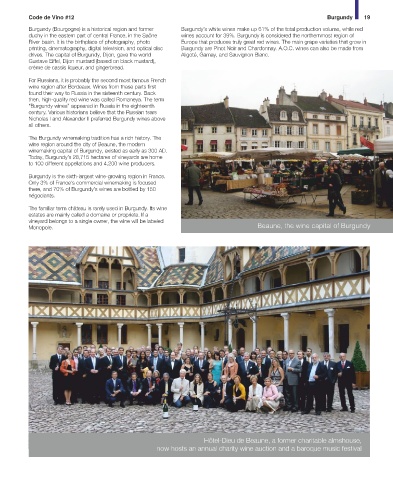
 Burgundy  The familiar term château is rarely used in Burgundy. Its wine    Beaune, the wine capital of Burgundy
         estates are mainly called a domaine or propriete. If a
         vineyard belongs to a single owner, the wine will be labeled
         Monopole.


 Author: Leonid Gelibterman


 This issue’s Space of Taste section presents one of the most interesting and
 distinctive wine regions in the world: Burgundy. Burgundy's wines are truly
 unique. Powerful yet refined, they have become a living embodiment of
 Bordeaux University oenology professor Denis Dubourdieu’s assertion that truly
 great wines are born on the border of warm and cold climates.

 Indeed, Burgundy is not the easiest place to produce wine. The weather is not
 always perfect, the terroir presents the winemakers with various challenges,
 and the wines vary from year to year. It takes a lot of effort. For example, some
 winemakers even use oil fired heat generators at their vineyards. So one could
 say that Burgundy wines are the result of tremendous work, the effect of which
 is only multiplied by the love of Burgundians for their land.

 In this article, our author, Leonid Gelibterman, explores the characteristics of   Hôtel-Dieu de Beaune, a former charitable almshouse,
 Burgundy wines, their complex system of classification, and much more.  now hosts an annual charity wine auction and a baroque music festival

