


Page 33 - Code de Vino, #17/23, a/w 2018
P. 33
32 Feature story Code de Vino #17 Code de Vino #17 Vercoope (Vinho Verde region) 33
Founded in 1964, Vercoope is the largest and most successful
cooperative of its kind uniting 5,000 winegrowers and
winemakers from seven subregions of Vinho Verde.
The cooperative specializes in promoting local wines, but even
more importantly focuses on the development of winemaking
in the region, education, and the compliance of technological
processes with modern demand in order to maintain the highest
quality and competitiveness of local wines.
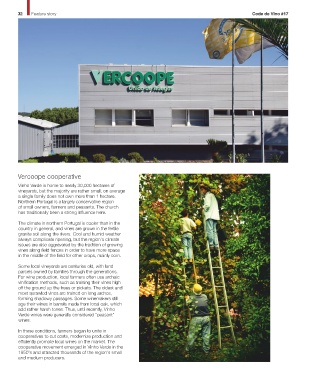
Thanks to the cooperative, new winemaking methods have been
introduced and are now being widely used in the region. Instead
of the old arches and training grape vines up trees, now locals
use grids and tall vertical frames grape pickers climb using a
ladder. Thus, grapes get more sun and are protected against
rotting in the rainy season after summer solstice in late June.
Thanks to better sun exposure, the grapes ripen and can be
picked sooner, placing the priority on quality over quantity.
Alternating agricultural methods promoted considerable
improvements in grape quality and helped change the
winemaking process for the better, ensuring a more stable
wine quality.
Today, Vercoope is more than just thousands of private vineyards:
it is the united wineries of seven regions of Vinho Verde. The
cooperative's head production is located in Agrela-Santo-Tirso.
Wines are produced under the proprietary brands of Via Latina
and Pavão. The cooperative pursues a highly effective marketing Vercoope wines
Vercoope cooperative policy focused on large markets. Vinho Verde wines have always been characterized by
a slight effervesce. This originally came from the malolactic
Vinho Verde is home to nearly 30,000 hectares of
vineyards, but the majority are rather small; on average fermentation taking place in the bottle, which made
a single family does not own more than 1 hectare. the wines more fruity and less light. In fact, they had
Northern Portugal is a largely conservative region to be packaged in opaque bottles to hide the sediment.
of small owners, farmers and peasants. The church
has traditionally been a strong influence here. Nowadays, this issue has been resolved. The wine
production process at Vercoope is supervised by a team
led by enologist Jo o Gaspar. His goal is to keep wines
The climate in northern Portugal is cooler than in the fresh, light, aromatic and somewhat "crisp" to stay
country in general, and vines are grown in the fertile in line with consumer demands.
granite soil along the rivers. Cool and humid weather
always complicate ripening, but the region's climate Low-temperature fermentation at 15 °С helps reach
issues are also aggravated by the tradition of growing a complete fermentation to preserve all the flavor and
vines along field fences in order to have more space aromatic properties of the grape varieties used. The slight
in the middle of the field for other crops, mainly corn.
effervesce the region's wines have been known for
historically is obtained at the next production stage, when
Some local vineyards are centuries old, with land a small amount of carbon dioxide is added (less than 1 bar
parcels owned by families through the generations. of pressure). In the past, Vinho Verde wines were less
For wine production, local farmers often use archaic predictable and the secondary fermentation could alter the
vinification methods, such as training their vines high taste of the wine or even destroy it, but now consumers get
off the ground up the trees or pickets. The oldest and a more refined, young wine of stable quality and with that
most sprawled vines are trained on long arches, familiar slight sparkle.
forming shadowy passages. Some winemakers still
age their wines in barrels made from local oak, which What are modern Vinho Verde DOP wines like? They are
add rather harsh tones. Thus, until recently, Vinho young and crisp wines made from autochthonous grape
Verde wines were generally considered "peasant" varieties, slightly sparkling, refreshing, low-alcohol, very light
wines. and easy-drinking. Their signature flavors include citrus
notes and apple, while pear and pineapple are rarer.
In these conditions, farmers began to unite in
cooperatives to cut costs, modernize production and Alongside traditional white wines, Vercoope also produces
efficiently promote local wines on the market. The rose and sparkling rose from local red grapes. We should
cooperative movement emerged in Vinho Verde in the also highlight Vercoope Via Latina wines, which are the
1950's and attracted thousands of the region's small most representative of the cooperative and region's style
and medium producers. in general.

