


Page 31 - Code de Vino, #12/18, s/s 2016
P. 31
30  The Space of Taste  Code de Vino #12  Code de Vino #12                             His Majesty Pinot Noir  31

 Another interesting thing about Pinot Noir
 is its high susceptibility to mutations. Many
 clones and mutations of this variety exist,
 with the most famous being Pinot Blanc,
 Pinot Gris, and Pinot Meunier.


 Pinot Noir is one of seven grape varieties officially
 approved for the production of sparkling white wine
 in the Champagne region. Champagne is also
 commonly made from Chardonnay and Pinot
 Meunier, and less often from Arbane, Petit Meslier,   Pinot Blanc
 Pinot Blanc, and Pinot Gris. The squeezed juice is
 macerated without pulp, which leaves the red grape
 juice white.


 This is why this grape is so popular on the ordinary wine
 market. This can work the other way around when it comes to
 signature wines: if all the conditions are met, the result will be
 a truly unique wine that reflects the characteristics of the
 place where it was created. It is only natural that the best
 Burgundy winemakers strive to produce wine in the same
 area where the grapes have been collected. Pinot Noir is very
 sensitive and condition dependent, but it can produce
 outstanding results if the winemaker puts in the effort. It can
 also be quite predictable if need be. In the two above
 mentioned cases, the difference between the wines will be
 tremendous, and this is also what makes this grape so   Pinot Gris
 special: great and ordinary Pinot Noir wines are worlds apart.
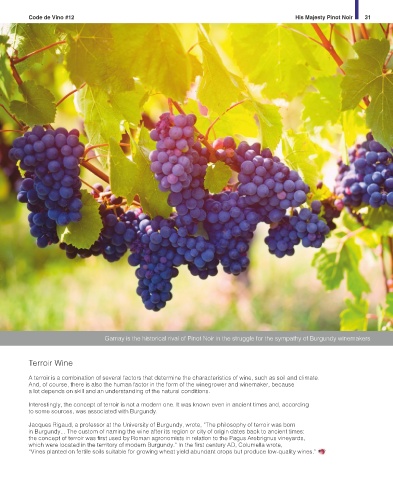
                                Gamay is the historical rival of Pinot Noir in the struggle for the sympathy of Burgundy winemakers
 Another interesting tradition connected with Pinot Noir from
 Burgundy is that to achieve the maximum transfer of the
 compounds accumulated by the berries, a part of the grapes   Terroir Wine
 is fermented (macerated) without removing the stalks. But, of
 course, this is only possible during good years and not in all   A terroir is a combination of several factors that determine the characteristics of wine, such as soil and climate.
 climates, and the stalks should not be green.
          And, of course, there is also the human factor in the form of the winegrower and winemaker, because
          a lot depends on skill and an understanding of the natural conditions.
 Pinot Noir requires constant attention and care, but if you find
 the right approach to it, the resulting wine will have a solid   Interestingly, the concept of terroir is not a modern one. It was known even in ancient times and, according
 structure, rich color, and the necessary acidity, giving it the
 ability to develop, preserve color, block the growth of   to some sources, was associated with Burgundy.
 microorganisms and oxidative enzymes, and create an
 abundance of evolving aromas together with its precursors. In   Jacques Rigaud, a professor at the University of Burgundy, wrote, “The philosophy of terroir was born
 Burgundy, Pinot Noir is practically never used in blends (with   in Burgundy... The custom of naming the wine after its region or city of origin dates back to ancient times:
 the exception of champagne). It is quite content to sit on the   the concept of terroir was first used by Roman agronomists in relation to the Pagus Arebrignus vineyards,
 throne of Burgundy's varieties, countenancing no co regent.  Pinot Meunier  which were located in the territory of modern Burgundy.” In the first century AD, Columella wrote,
         “Vines planted on fertile soils suitable for growing wheat yield abundant crops but produce low quality wines.”

